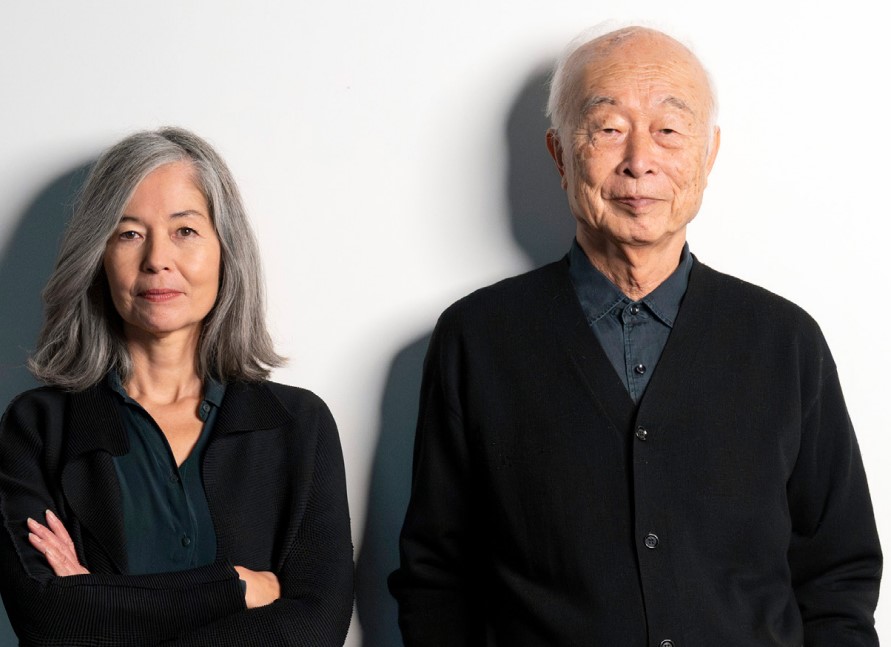
After graduating from the Tokyo University of the Arts, Makio Hasuike founded Makio Hasuike & Co. in Milan in 1968, one of the first industrial design studios in Italy, where since 1999 he has worked with his daughter Naomi. In 2016 he received the Compasso d’Oro Award for Lifetime Achievement. He is a member of the Founding Committee of the Strategic Design Master’s programme at the Politecnico di Milano and has taught at the School of Design of the Politecnico di Milano, Domus Academy and Istituto Raffles Milano. His designs have received numerous international awards.
"TODAY’S COMPLEXITY
MAKES ME THINK
THAT UNDERSTANDING
AND ACHIEVING A
SENSE OF MEASURE
IS EVEN MORE
ESSENTIAL THAN IT
WAS IN THE PAST"
«I have never thought about having a personal style or about what it should be. Yet in the many projects I have completed I can see a certain recognisability and continuity, both in the way they
were approached and in the result of formal balance that I see in them,» Hasuike says.
From the 1970s to the present day, Hasuike has developed furniture, household appliances, utensils and accessories for the kitchen sector. For Aran Cucine he designed Natura and Sipario. «I also remember the Ingegno 5 cookware set for Tefal and the Arte cutlery for Auerhahn. When it comes to household appliances, I have put a great deal of energy into them because they impose requirements such as functionality, safety and other parameters that demand rationality; at the same time they must have personality. This complex experience, lasting many years, shaped the whole way I go about designing».
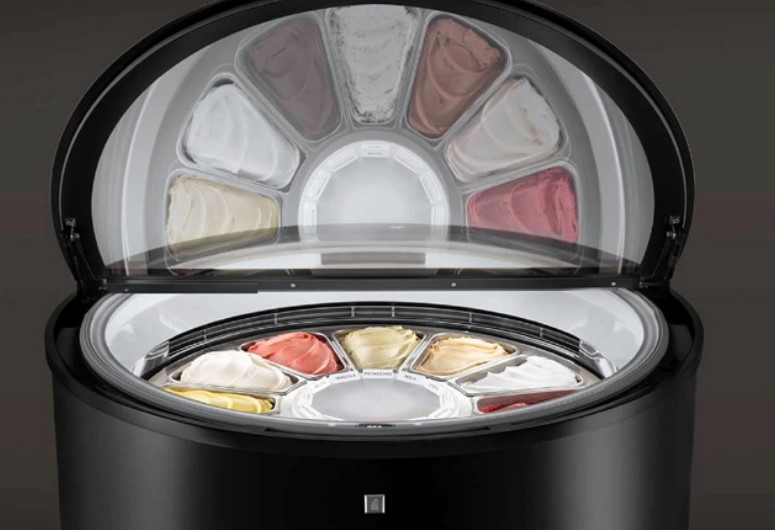
In a world flooded with redundant products, Hasuike manages to come up with designs that are necessary and, though complex, are free from superfluous decoration. «When tackling complex projects, our challenge is to support the idea that an ‘object’ should first and foremost be pleasing. This is how we conceived the Tonda rotating gelato display by IFI, for instance, and the cargo bikes LAMBROgio and LAMBROgino created for RePower. In general, my and my studio’s aim is to bring material closer to the person, the utensil closer to the user. We seek to
find a balance, not to ‘overdo it’ by overloading objects with messages».
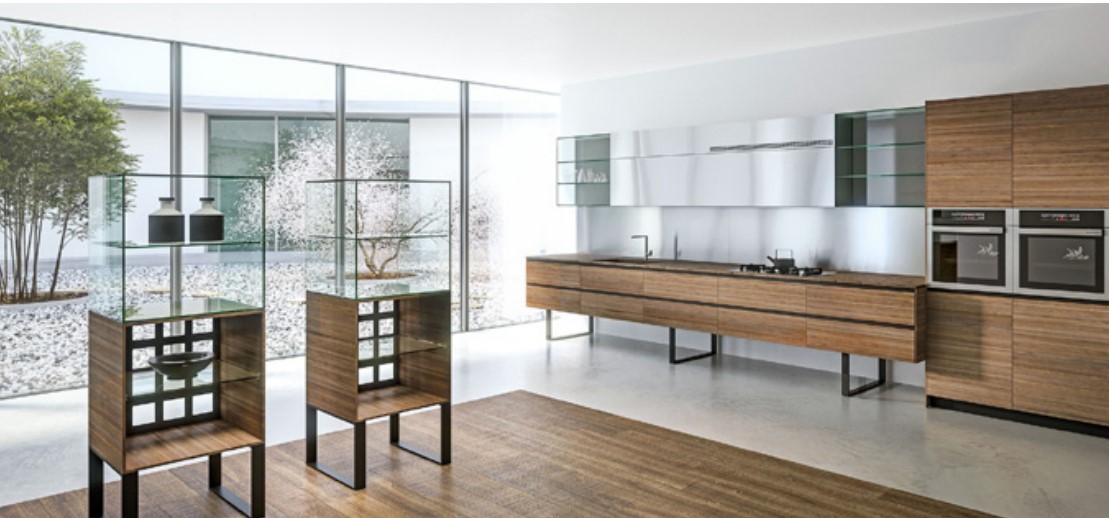
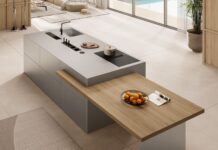
A fundamental concept for the designer is precisely this sense of measure, clearly expressed in the Sipario kitchen by Aran Cucine, which is considered an ideal of order and rationality, a fusion of essential lines and technological complexity. «Sipario was designed by imagining a visually light and spacious kitchen. By raising the volumes off the floor, the space appears brighter and more cheerful; at the same time access to the cabinets and cleaning the floor are made easier. To convey a sense of ease and hospitality and to allow one to ‘move lightly’, the excessively functional and expressively harsh technological elements (handles, knobs, lights, buttons and so on) have been concealed». The model is based on a strong concept: the kitchen considered as a place of “theatrical”
representation, where both the chef and the diners are the main players. «As we know, the kitchen is the central space in the home, where a little bit of everything takes place and where we live together with others. During preparation, Sipario (the name is the Italian word for a theatre curtain) opens up and the equipment is revealed. When the work is done, the performance ends too: the curtain closes and everything disappears. If those living in this space with family and friends feel like actors, then I can say the project has done what it set out to do».
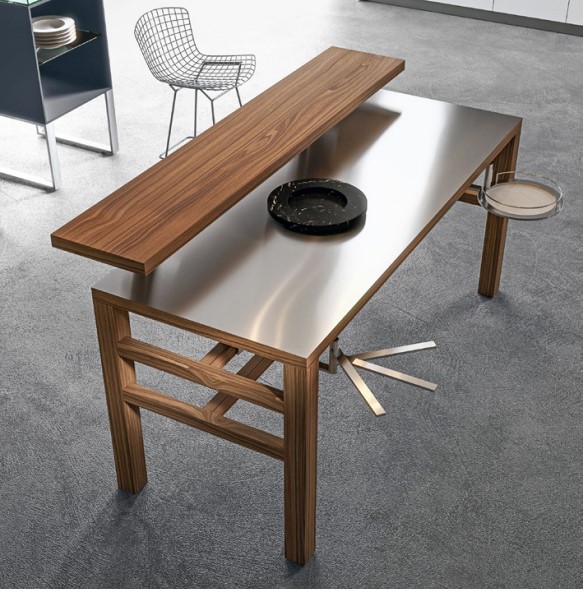
Sipario can be complemented by the Bis table, a dynamic model with a folding shelf that lifts and can be positioned above the tabletop. «It’s not very nice for someone working in the kitchen to be isolated; participation and sharing are fundamental conditions for this design project. The Bis table, designed for food preparation, can also become a small desk for taking notes or studying. Here younger people can take part in or learn about kitchen activities. Involving the young in the things adults do means passing on to future generations and enriching our food culture».